Choosing the right kitchen scale is essential for bakers who want consistent dough hydration, precise flour measurements, and reliable ingredient control. The following picks focus on bread-friendly accuracy, large readable displays, and sturdy construction suitable for kneading bowls, bowls, and baking sheets. Each option supports tare functions, multiple units, and easy conversion between grams and ounces for precise ratios. Read on to compare pros, features, and what to prioritize when shopping for a bread-focused kitchen scale.
| Product | |||
|---|---|---|---|
| Etekcity Food Kitchen Scale (Model 11 lb) | 11 lb / 5 kg | 1 g | Compact, reliable, easy storage |
| Nicewell Food Scale | 22 lb / 10 kg | 1 g / 0.1 oz | Large platform, durable surface |
| GGQ Food Scale | 33 lb / 15 kg | 1 g | Two platforms for large bowls |
| KUAIVO Dual Platform Scale | Small & Large scales combined | 0.001 oz / 0.1 oz | Dual-range versatility |
| CROWNFUL Food Scale | 33 lb / 15 kg | 1 g | Rechargeable, Type-C and battery power |
Etekcity Food Kitchen Scale, 11 lb

The Etekcity 11 lb digital scale combines compact design with dependable accuracy, making it a practical choice for bread bakers who measure flour, water, and other ingredients in small to medium batches. It supports five units, including oz, lb:oz, fluid ounces, grams, and milliliters, which helps align recipes from different sources. A tare function allows you to zero out bowls and containers, enabling precise incremental additions—critical when scaling bread dough. The scale weighs up to 11 pounds with 1-gram resolution, which is ample for typical bread recipes and starter feeds. Its small footprint makes it easy to store in a cabinet or drawer between bakes. The model ships with two AAA batteries for immediate use, so you can start weighing right away.
Pros for bread bakers: precise 1 g increments ensure accurate hydration and flour-to-water ratios; the tare feature simplifies measuring multiple ingredients in succession; slim form factor fits tight kitchen spaces. Potential downsides: some users may prefer a larger top surface for very large bowls; the 11 lb capacity may require multiple weigh-ins for very large dough batches or bulk flour.
Nicewell Food Scale
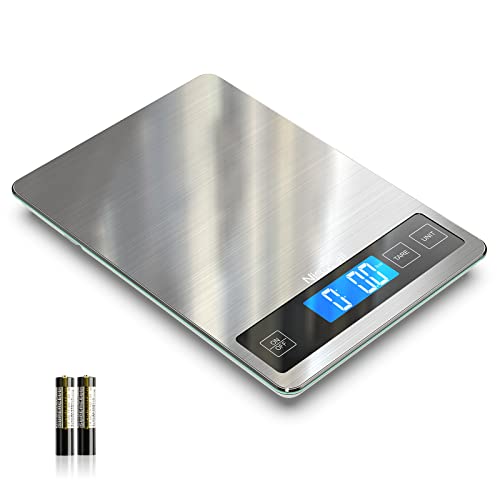
The Nicewell scale delivers a larger platform and robust measurement range, ideal for bakers who frequently weigh bulk ingredients or larger bowls. With four high-precision load sensors, the scale provides accurate readings in 1 g or 0.1 oz increments across a broad range from 0.1 oz to 22 lb, and up to 10 kg. The 9″ x 6.3″ platform offers ample space for dough bowls, measuring cups, or pans without crowding the counter. The device displays in multiple units (g, kg, lb:oz, fl oz, ml), making it easy to convert recipes from different sources. A tempered glass top reduces fingerprint marks and makes cleaning straightforward. A storage hook adds convenience when the device is not in use.
For bread making, the Nicewell scale shines when you need to measure large quantities of flour or water in a single batch. Its readability is aided by a large LCD display, which minimizes eye strain during long mixing sessions. On the downside, the larger platform may require a bit more counter space, and some users report that the initial setup benefits from recalibration for ultra-precise results in scientific baking experiments.
GGQ Food Scale
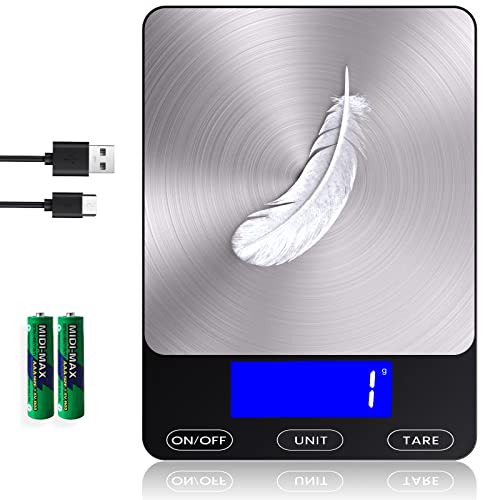
The GGQ digital kitchen scale emphasizes a balance of capacity and durability with a 33 lb (approximately 15 kg) maximum. It features four high-precision load sensors, a waterproof anti-collision glass panel, and seven common measurement units (g/kg/lb:oz/oz/ml). The 7.5″ by 5.5″ stainless steel panel provides sturdiness for weighing larger dough bowls or bags of flour. A Type-C rechargeable battery option enhances convenience, and the scale includes a USB-C charging cable for quick top-ups between bakes. The tare function lets you ignore container weight, ensuring precise ingredient measurements essential for bread recipes that demand accurate hydration percentages.
For bread bakers, the larger capacity is beneficial when scaling up some formulas or preparing multiple dough batches. Some users may find the surface slightly reflective, which can momentarily affect readability in bright kitchens, though the large panel generally improves visibility. Cleaning is straightforward due to the wipe-clean surface, but care should be taken with the water resistance rating, especially around the charging port.
CROWNFUL Food Scale
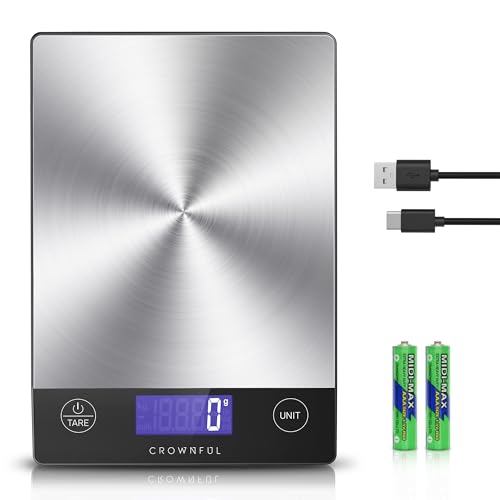
The CROWNFUL scale is designed for flexibility with a 33 lb/15 kg capacity and an easy-to-read LCD display. It offers Type-C charging or battery operation, making it useful in kitchens with limited outlets or during power outages. The large stainless steel panel can accommodate bigger bowls or trays, which is helpful when weighing whole dough masses before kneading or measuring bulk ingredients for bread starters. The device emphasizes a balance between accessibility and accuracy, delivering 1 g precision across a wide range. The inclusion of Type-C charging helps keep your scale ready for back-to-back baking sessions without frequent battery changes.
For serious bread bakers, the rechargeable feature can be a time-saver, and the large panel is advantageous for weighing large quantities. However, some users may prefer a slightly smaller footprint for compact kitchens, and occasional calibration may be needed to ensure consistent 1 g steps across all units.
Buying Guide: Key Considerations For Bread Baking
- Capacity: Bread recipes often begin with larger quantities of flour and water. Look for scales with at least 2–5 kg capacity if you regularly bake with batches larger than a standard loaf.
- Precision: For accurate hydration and dough ratios, aim for 1 g or better increments. Some scales offer 0.1 g or 0.01 g precision, which is useful for sourdough starters and precise levain calculations.
- Tare And Accumulation: A tare function is essential to subtract container weight, while accumulation lets you sum multiple ingredients in one go—helpful when building a recipe with several components.
- Display And Readability: A large, clear display reduces eye strain during long bake sessions. Consider angled or tilting displays for easier reading over bowls and pans.
- Surface And Cleaning: Stainless steel or tempered glass surfaces resist mess and are easier to clean after sticky dough handling. Waterproof or water-resistant features are a bonus for measuring liquids.
- Power Options: USB-C rechargeable batteries provide convenience for frequent bakers who don’t want to replaced batteries often, while traditional battery-powered units can be more portable.
- Unit Versatility: Bread recipes sometimes originate from different regions; scales that support g, kg, lb:oz, ml, and fl oz simplify conversions across sources.
- Size And Footprint: Consider the scale’s footprint relative to your counter space and the size of your bowls. A larger platform can be advantageous for dough bowls but may take up more space.
- Durability: For frequent use, select scales with sturdy construction and high-quality sensors. A model with a solid chassis reduces drift and wear over time.
- Calibration: Some scales benefit from occasional calibration with standardized weights to maintain accuracy, especially if used for scientific or precise bread formulas.
User Scenarios And Recommendations
For beginners focusing on basic bread recipes, an 11–22 lb capacity with 1 g precision strikes a practical balance between cost and functionality. Bakers who regularly work with large loaves or dense doughs may prefer 33 lb capacity scales with robust platforms to prevent tipping or platform flex. If you often measure liquids or starter feeds with the same scale, a waterproof or IPX-rated design reduces cleanup time and protects sensors from moisture exposure. Finally, choose a scale with an intuitive tare function and a straightforward display to minimize friction during repeated weighings in a busy kitchen.